Estate Planning & Administration
Pennsylvania Inheritance Tax: Complete Guide
Last updated February 2026
 Marc R. Lynde, Esq.
5 min read
✓ Verified Feb. 2026
Marc R. Lynde, Esq.
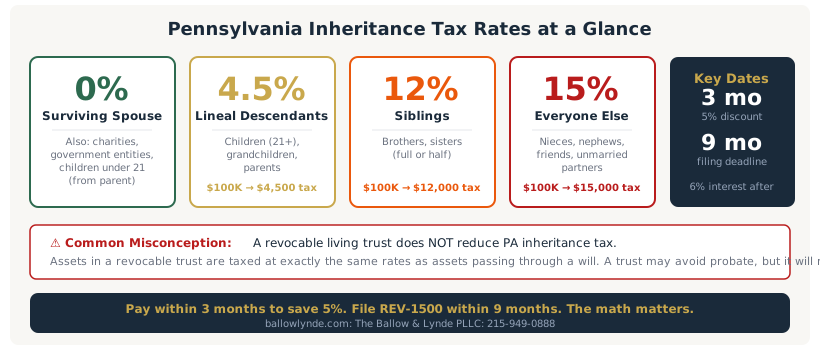
Pennsylvania's inheritance tax is imposed on the transfer of property at death under 72 P.S. § 9116. The rate depends solely on the relationship between the decedent and the beneficiary:
Surviving spouse: 0% (completely exempt). Children, grandchildren, and parents: 4.5%. Siblings: 12%. All other individuals: nieces, nephews, friends, unmarried partners, cousins: 15%. Charities and government entities: 0%. For deaths on or after January 1, 2020 (Act 13 of 2019), transfers to or for the use of a child age 21 or younger from a natural parent, adoptive parent, or stepparent are taxed at 0%.
These rates apply to the net value of property transferred to each beneficiary, meaning gross value minus allowable deductions. Every beneficiary class is taxed separately on Schedule J of the return.
The REV-1500 return is due within nine months of the date of death. If you pay the full tax within three months of death, the estate receives a 5% discount on the total tax due. On a $500,000 estate passing to children (4.5% rate = $22,500 tax), that discount saves $1,125. Interest accrues on unpaid tax beginning nine months and one day after death.
Even if you cannot prepare the full return within three months, you can make an estimated pre-payment to the Register of Wills and still claim the discount on the amount paid. This is one of the most commonly missed opportunities in estate administration.
The estate may request a filing extension using Form REV-1846, but an extension to file does not extend the time to pay; interest still accrues after nine months. And Pennsylvania does not allow amended returns. If the Department later assesses a different value, any dispute goes through the administrative protest or appeal process.
The Pennsylvania Inheritance Tax Return (Form REV-1500) is a three-page cover document supported by individual schedules, each one a separate form with its own REV number. You only file the schedules that apply to the estate.
Schedules A through G report assets: real estate (A), stocks and bonds (B), closely held business interests (C), mortgages owed to the decedent (D), cash, bank accounts, and personal property (E), jointly held property with non-spouses (F), and non-probate transfers including retirement accounts, life insurance, trusts, and lifetime gifts (G).
Schedules H and I report deductions: funeral and administrative expenses (H) and the decedent's debts, mortgages, and liens (I). These reduce the taxable estate.
Schedule J computes the tax: it lists every beneficiary, their relationship, what they receive, and the tax owed at the applicable rate.
Schedules K through O handle specialized situations; life estates, remainder interests, future interest compromises, credits for prior transfers, and spousal trust elections. Most estates don't need them.
For a detailed walkthrough of each schedule (what to report, which form number to use, and what the Department is checking) see our REV-1500 Schedules Guide.
The inheritance tax return looks straightforward on the surface; list assets, subtract deductions, apply rates. In practice, it's one of the filings most likely to generate a deficiency notice from the Department of Revenue. Here's why:
Real estate valuation. The Department doesn't accept whatever value you report. They cross-check it against the county's assessed value multiplied by the Common Level Ratio (CLR). In Bucks County, the current CLR factor is 17.06 (July 2025 to June 2026): a property assessed at $20,000 has a computed fair market value of $341,200. Report too low without a professional appraisal and you'll hear from Harrisburg.
Retirement accounts. IRAs, 401(k)s, and pensions with named beneficiaries bypass probate entirely, which is why executors often forget to include them. They're taxable on Schedule G, and for many estates they're the single largest tax item on the return.
Jointly held property. Joint accounts between parent and child are fully taxable unless the child can prove they contributed their own funds. Joint property between spouses held for more than one year is exempt. Mixing these up triggers either unnecessary tax or a deficiency notice.
Lifetime transfers. Gifts made within one year of death, added joint owners, changed beneficiary designations, transfers with retained life estates, all taxable on Schedule G. The Department reviews bank records and deed transfers closely.
Business interests. Closely held business valuations are among the most contested items on the return. Marketability and minority discounts require qualified appraisal support the Department will accept.
Every one of these issues requires judgment calls about valuation, classification, and documentation. That's where professional preparation pays for itself, often by avoiding a deficiency assessment that would cost more than the fee.
The return is filed with the Register of Wills at 55 East Court Street, Sixth Floor, Doylestown, not at the Government Service Centers in Levittown or Quakertown. Two copies are required (one signed original). After filing, the status can be tracked through the Department of Revenue's myPATH portal. Pre-payments can be submitted before the return is ready; provide the decedent's full name, date of death, and Social Security number with a check payable to "Register of Wills, Agent."
There's no legal requirement. But the return is a formal tax filing with legal consequences; errors can result in deficiency assessments, interest, and personal liability for the executor. Most estates with real estate, retirement accounts, or business interests benefit from professional preparation.
It depends. Life insurance payable to a surviving spouse is exempt. Life insurance payable to the estate is taxable on Schedule E. Life insurance payable to any other named beneficiary is reported on Schedule G. It must be disclosed, though it may qualify for exemption under 72 P.S. § 9111(a). The details matter, and getting the classification wrong triggers a deficiency notice.
Property held between spouses as tenants by the entireties or joint tenants with right of survivorship for more than one year before death is completely exempt and does not need to be reported on any schedule.
No. Pennsylvania does not allow amended inheritance tax returns. If you discover additional assets, you file a supplemental return. If a value is disputed, you go through the Department's protest process. This is one of the strongest reasons to get it right the first time.
I prepare Pennsylvania Inheritance Tax Returns for estates in Bucks County and surrounding areas. Call 215-949-0888 or request a free consultation.
Statutory content on this page was last verified against Pennsylvania statutes (20 Pa.C.S.; 72 P.S. Art. XXI): February 2026. If you are reading this significantly after that date, confirm key provisions with current statute text or contact our office.