Estate Planning & Administration
Irrevocable Trusts: Types, Uses & When They Matter
Last updated February 2026
 Marc R. Lynde, Esq.
8 min read
✓ Verified Feb. 2026
Marc R. Lynde, Esq.
An irrevocable trust is one the settlor cannot revoke, amend, or withdraw property from after execution; at least not without the consent of all beneficiaries and, in some cases, court approval under 20 Pa.C.S. § 7740.1. That permanence is the point. It’s what separates an irrevocable trust from a revocable (living) trust, and it’s what makes irrevocable trusts useful for asset protection, tax planning, and Medicaid eligibility.
If you’ve read our overview of trusts in Pennsylvania , you know that revocable trusts don’t save taxes and don’t protect assets from creditors. Irrevocable trusts can; but at a cost. Once you transfer property into one, you give up control. Understanding when that tradeoff is worth it is the entire analysis.
Pennsylvania’s Uniform Trust Code (20 Pa.C.S. Ch. 77, substantially amended by Act 64 of 2024) governs all trusts created or administered in the Commonwealth. Several provisions are particularly important for irrevocable trusts:
Spendthrift protection (§ 7741): A spendthrift provision in an irrevocable trust prevents the beneficiary ’s creditors from reaching trust assets before distribution. Pennsylvania presumes that a spendthrift provision constitutes a “material purpose” of the trust (§ 7740.1(b.1)), making it harder for beneficiaries to terminate the trust even with unanimous consent.
Modification limits (§ 7740.1): An irrevocable trust can only be modified by consent of the settlor and all beneficiaries, or by all beneficiaries alone if the court finds the modification isn’t inconsistent with a material purpose. If some beneficiaries won’t consent, the court may still approve if it finds their interests are adequately protected.
Court modification (§ 7740.2): Even without consent, a court can modify an irrevocable trust if unanticipated circumstances have arisen since creation and the modification furthers the trust’s purposes.
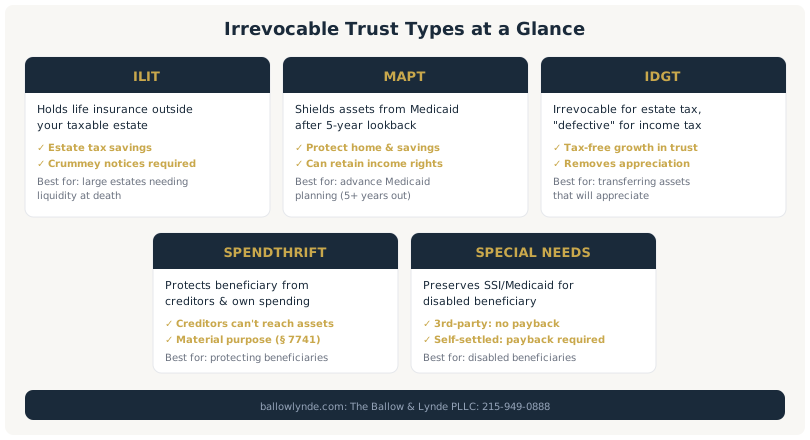
An ILIT holds life insurance policies outside your taxable estate. The trust (not you) owns the policy, so the death benefit isn’t included in your estate for federal estate tax purposes. For Pennsylvania inheritance tax, the analysis turns on the “incidents of ownership” test: if the insured retains no ownership or control, the proceeds are not taxable under 72 P.S. § 2111(a).
ILITs require careful administration. Premium payments are treated as gifts to the trust, so the trustee must issue “Crummey notices” to beneficiaries giving them a temporary right of withdrawal; this qualifies the gifts for the annual gift tax exclusion.
A MAPT transfers assets beyond the reach of Medicaid’s eligibility calculation, but only after the 5-year lookback period expires. The settlor typically retains the right to live in a transferred residence and receive income, but cannot access principal. See our Medicaid planning strategies page for details on timing and structuring.
An IDGT is irrevocable for estate tax purposes but intentionally “defective” for income tax purposes; meaning the grantor continues to pay income taxes on the trust’s earnings. This effectively allows the trust to grow tax-free (since the grantor’s tax payments are not treated as additional gifts), while removing the assets from the grantor’s estate. IDGTs are commonly used in tandem with installment sales to transfer appreciating assets.
The distinction matters for income tax. A grantor trust is one where the settlor retains enough control that the IRS treats the trust’s income as the settlor’s (IRC §§ 671 to 679). A non-grantor trust is a separate taxpayer that files its own return (Form 1041) and pays tax at compressed rates; reaching the highest federal bracket at just $15,650 (2025). For Pennsylvania purposes, non-grantor trusts pay the flat 3.07% income tax on undistributed income.
Any irrevocable trust can include a spendthrift provision (§ 7741), but trusts designed primarily to protect a beneficiary from creditors or from their own spending habits are commonly called spendthrift trusts. Pennsylvania’s spendthrift protection is strong: creditors generally cannot attach a beneficiary’s interest before distribution. Exceptions exist for child support obligations and certain government claims.
We cover these in detail on our Special Needs Trusts page. The key distinction: third-party SNTs (funded by someone other than the beneficiary) have no payback requirement, while self-settled SNTs (funded by the beneficiary’s own assets) require repayment to the Commonwealth upon death under 42 U.S.C. § 1396p(d)(4)(A).
Transfers into an irrevocable trust are potentially subject to Pennsylvania inheritance tax at the time of the settlor’s death, depending on whether the settlor retained an interest. Under 72 P.S. § 9107, transfers where the settlor retained an income interest, use of property, or a reversionary interest are taxable. The rate depends on the beneficiary’s relationship to the settlor: 0% for spouses, 4.5% for lineal descendants, 12% for siblings, and 15% for everyone else (72 P.S. § 9116).
Consider an irrevocable trust when you need to accomplish something a revocable trust cannot:
The Tradeoff
Every irrevocable trust involves a fundamental exchange: you give up control in return for a benefit; tax savings, asset protection, or eligibility for public benefits. The trust must be properly drafted, properly funded, and properly administered. The cost of getting it wrong can exceed the cost of never creating one at all.
Statutory content on this page was last verified against Pennsylvania statutes (20 Pa.C.S.; 72 P.S. Art. XXI): February 2026 . If you are reading this significantly after that date, confirm key provisions with current statute text or contact our office.
Free consultations available for most practice areas.
Book a Free Consultation Or call 215-949-0888